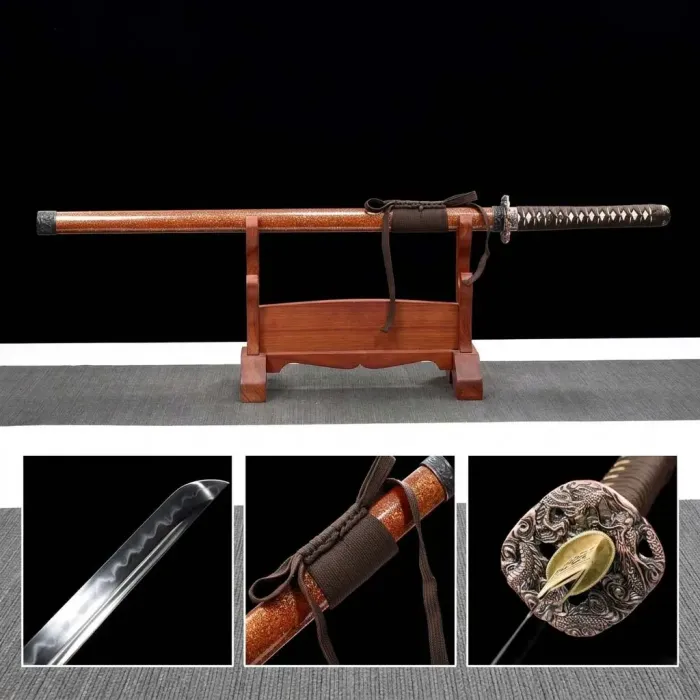
Every customary eastern blade is a splendid masterpiece of skill, but assume you need to convey your individual character? Refining your armament is a insightful journey, allowing you to forge a truly rare piece. From the tsuka wrapping and clasp to the plate design and edge design, each constituent offers a chance for custom touch. This inquiry delves into the realm of katana enhancements, providing tips for both newcomers and expert enthusiasts hoping to make their signature on the classical art of the samurai.
Newcomer's Legitimate Skill
For those hoping to embark on the satisfying journey of traditional blade practices , 1060 steel katanas deliver an superior entry point. This selected grade of carbon steel hits a optimal point between economical cost and proficiency. While not as hard as premium steels, 1060 permits a acceptable level of knife work , making it tailored to trainees to improve the fundamentals of blade care and enjoy the charm of genuine Japanese weaponry. It’s a excellent choice for acquiring experience without the capital burden of more high-grade steels.
Ten Ten Steel Cutting Tools : Managing Efficiency and Budget
Enabling aficionados seeking an authentic saber experience without busting the wallet , T10 metal katanas represent a compelling option. These tools offer a significant improvement in robustness compared to inferior alternatives, exhibiting sufficient edge retention and ample flexibility for simple chopping techniques. While not rivaling the exceptional characteristics of fine steels like T100 or folded element , T10 provides a commendable blend of utility and price , making them a common choice for apprentices and those on a restrained funds.
Moving beyond the Keel : Tailoring Your Sword's Attachments and Shaft
Despite the polished metallic edge is undeniably the core point of a katana, truly refining its magnificence lies in the deliberate customization of its ornamentation and hold. This method allows collectors to present their one-of-a-kind taste . Weigh the wide possibilities: menuki - decorative appliqués that offer visual allure ; the hamon encasements – often delicately carved ; the tsuka foundation itself, wrapped in customary ito string ; and the fusa end piece , which can be constructed from various components like valuables or ivory .
- Prefer concepts that echo with you.
- Test with distinctive components .
- Accent durability for a continuing impression .
The Enchantment of the Katana: Past, Crafting, and Elements
An eastern saber shows a distinctive allure, steeped in eras of Pacific Rim history and heritage . More than merely a device of skirmishing, it's a representation of the fighter ethos – a fusion of ability and discipline . Its progression spanned various generations, with early cutting tools evolving into the graceful curvature and lethal edge we perceive today. The manufacture involved is truly spectacular, requiring decades of study to excel at . The process involves a elaborate folding of metal bloom, creating layers that enhance the metal’s flexibility and cleaving ability. Several schools of manufacturing were established, each with their own secrets and methods for achieving the perfect stability and precision - a truly grueling pursuit.
- Original Katana styles
- The importance of the traditional blade in samurai culture
- Traditional smithing processes
Deciding the Best Steel for Your Japanese Sword Project: 1060 vs. T10
Deciding on the suitable steel is critically important for any sword project, and the choice between 1060 and T10 can be complex. 1060 is a popular American steel, offering a good balance of rigidity and endurance, supplying it reasonably easy to forge. However, T10, a East Asian steel, commonly boasts enhanced wear endurance and can potentially achieve a higher terminal hardness, although it can be substantially hard to manage and requires careful heat processing. Consider your background and projected results: for a trainee, 1060 may be a more straightforward launchpad, while the proficient smith might favor the increased traits of T10.
- Facility of Processing
- Wear
- Terminal Tenacity
Opening the Possibilities: Elite Katana Enhancement Procedures
Honing the expertise in edge enhancement extends far beyond basic stropping. Serious professionals are now investigating advanced techniques to truly expose a blade's hidden potential. This features intricate work with the temper pattern, utilizing specialized compositions for differential heat treatment and carefully selecting the configuration of the guard to optimize balance and operation. Beyond purely functional changes, artisans are increasingly focused on achieving unparalleled aesthetic style, through complex engraving and layered films that truly transform a katana into a creation.
Transforming Basic Steel into Art: Building a 1060 Sword
The journey initiates with common 1060 material , a rigid material far separated the refined katana it will turn into . Skilled bladesmiths apply a multifaceted process of combining and fabricating the crude steel, repeatedly burning it and flattening it to extract impurities and build a uniform grain structure. This exhausting process, often going on for months , builds the imperative strength and give characteristic of a legitimate Japanese tool. Subsequent heat adjustments , including careful t10 steel katana hardening and annealing , are necessary to achieve the aimed balance of sharpness, endurance and loveliness .- Uniting: Reduces impurities and forms grain structure.
- Hammering: Creates the steel into the initial blade form.
- Heat Treatment: Sets the final hardness and flexibility.
The Durable Charm of the Katana: Intensive Inspection of Steel and Adaptation
The iconic katana persists a forceful symbol signifying Japanese style , its draw far surpassing mere combat tools . Forged from unique steel and commonly featuring intricate motifs , the procedure of creation itself is a esteemed art. Beyond the essential craftsmanship, the ability to alter a katana - from the temperation to the hold wrapping and sheath - facilitates for a wholeheartedly individual exhibition for both curators and practitioners alike. This confluence of historical steelwork and boundless personalization creates the katana's continued widespread acceptance across the universe.