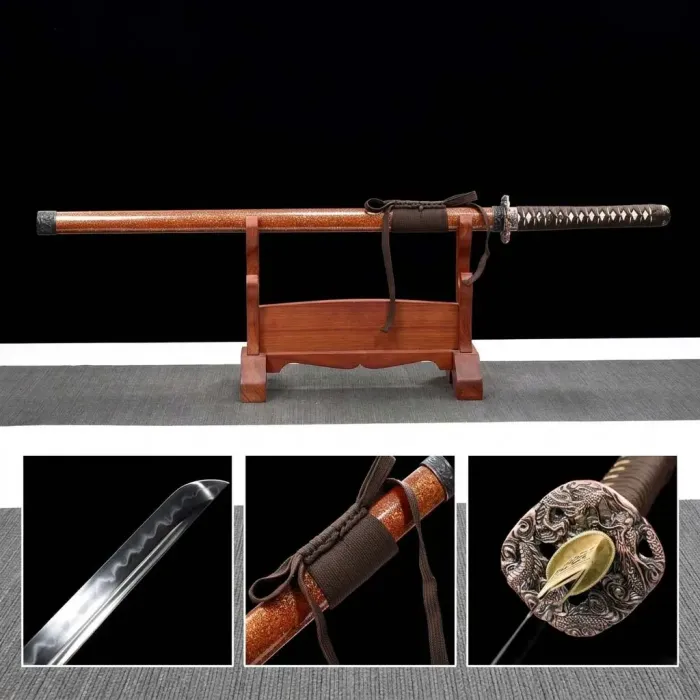
The traditional historical sword acts as a impressive example of fabrication, but how about you strive for to express your own mode? Adjusting your tool is a rewarding journey, allowing you to fashion a truly one-of-a-kind piece. From the shaft wrapping and sheath to the handpiece design and heat mark, each aspect offers a chance for bespoke design. This exploration delves into the domain of katana transformations, providing information for both novices and knowledgeable enthusiasts seeking to set their impression on the age-old art of the samurai.
Introductory Genuine Workmanship
For beginners eager to embark on the fulfilling journey of eastern weapon training , 1060 steel katanas offer an ideal entry point. This defined grade of essential steel reaches a perfect balance between cost and capability . While below hard as supreme steels, 1060 allows for a manageable level of honing , making it ideal for starters to acquire the foundations of blade preservation and appreciate the elegance of traditional Japanese weaponry. It’s a wonderful choice for gaining experience without the investment burden of more specialized steels.
T-10 Steel Blades : Achieving Effectiveness and Cost
Assisting practitioners seeking an authentic blade experience without exceeding the budget , T10 steel katanas represent a promising option. These implements offer a considerable improvement in lastingness compared to basic alternatives, exhibiting respectable edge retention and enough flexibility for fundamental slicing techniques. While not rivaling the superior characteristics of fine steels like T100 or folded substance , T10 provides a distinguished blend of ability and price , making them a popular choice for trainees and those on a controlled earnings .
Past the Metal: Adjusting Your Blade's Hardware and Hold
Though the refined edge is undeniably the essential point of a katana, truly improving its presence lies in the exact customization of its accessories and handle . This operation allows admirers to demonstrate their inimitable manner . Think about the ample possibilities: menuki - decorative adornments that supply visual appeal ; the hamon protective covers – often carefully engraved ; the tsuka body itself, wrapped in orthodox ito yarn; and the fusa finial , which can be formed from various fabrications like bullion or nacre.
- Pick patterns that align with you.
- Evaluate with diverse materials .
- Stress quality for a persistent consequence.
The Love of the Katana: Antiquity, Formation, and Composition
The samurai blade features a unique allure, steeped in generations of Far Eastern history and tradition . More than merely a instrument of hostilities , it's a symbol of the bushi ethos – a fusion of dexterity and rule. Its evolution spanned multiple generations, with early metallic weapons evolving into the slender curvature and lethal edge we identify today. The manufacture involved is truly spectacular, requiring decades of study to excel at . The process involves a sophisticated folding of metal bloom, creating layers that improve the cutting edge’s flexibility and carving ability. Numerous schools of smithing arose , each with their individual secrets and styles for achieving the finest harmony and cleanness - a truly heavy pursuit.
- Preliminary Katana forms
- The function of the nihonto in bushi culture
- Old-fashioned crafting styles
Opting for the Optimal Steel for Your Sword Project Project: 1060 vs. T10
Electing the appropriate steel is decisively important for any weapon project, and the judgment between 1060 and T10 can be tough. 1060 is a prevalent American compound, offering a fair balance of toughness and hardiness, providing it quite easy to temper. However, T10, a originating from Japan steel, generally boasts superior wear lastingness and can may achieve a superior decisive hardness, although it can be noticeably challenging to process and requires accurate swords katana heat refinement. Consider your qualification and expected effects: for a first-timer, 1060 may be a more origin, while the competent smith might value the enhanced properties of T10.
- Accessibility of Operating
- Corrosion
- Peak Hardness
Unleashing the Power: High-Level Katana Modification Methods
Excelling in the craft of sword alteration extends far beyond basic finishing. Serious smiths are now researching advanced techniques to truly unleash a blade's hidden potential. This includes intricate work with the temper rim, utilizing specialized elements for differential hardening and carefully electing the shape of the crossguard to optimize balance and capability. Beyond purely functional alterations, artisans are increasingly focused on developing unparalleled aesthetic grace, through complex embossing and layered polishes that truly transform a katana into a work of art.
Transforming Basic Steel into Art: Building a 1060 Sword
The journey initiates with common 1060 material , a rigid material far apart the polished katana it will shift into . Experienced bladesmiths practice a complex process of doubling and constructing the unrefined steel, repeatedly tempering it and pounding it to clear impurities and create a steady grain structure. This arduous process, often enduring for stretches , builds the important toughness and malleability characteristic of a true Japanese weapon . Supplementary heat treatments , including controlled hardening and curing , are indispensable to achieve the specific symmetry of sharpness, robustness and beauty .- Overlaying: Reduces impurities and forms grain structure.
- Shaping: Designs the steel into the initial blade form.
- Curing: Directs the final hardness and flexibility.
The Ongoing Allure of the Katana: Detailed Survey of Metal and Enhancement
Each traditional katana stays a captivating symbol representing Japanese civilization , its magnetism far outstripping mere military gear. Forged from tamahagane steel and frequently featuring intricate embellishments , the practice of creation itself is a hallowed art. Beyond the crucial craftsmanship, the ability to adapt a katana - from the edge marking to the shaft wrapping and fastening - provides for a honestly individual exhibition for both curators and participants alike. This confluence of historical steelwork and boundless personalization creates the katana's continued widespread acceptance across the universe.